
My new phone has AI-driven capabilities I discover and then turn off. AI was making decisions for me about when I wanted notifications silenced and where in a song I wanted to begin listening. I know it was trying to optimize my experience. But optimization is suboptimal if the price in unpredictability is too high.
Welcome to modern manufacturing, and the tension manufacturers will have to confront as programmed automation potentially gives way to AI-driven autonomy in manufacturing systems. The limiting of autonomy I made on my phone matches the kind of limits that might need to be defined for factories. The AI-driven autonomy in manufacturing is largely unavailable yet, at least in discrete part production, but all the pieces are advancing and it will be a possibility soon. Given that we require manufacturing to be repeatable and we expect it to be repetitive, where does autonomy in manufacturing make sense?
I recently wrote a report for ASTM International on AI and the Path Toward Autonomous Manufacturing. The basis of the report was a workshop hosted by ASTM and the University of Tennessee, Knoxville, assembling various researchers and other experts involved in the growing interconnection between manufacturing and AI. Autonomy in manufacturing was not the direct focus for most of the AI experts present, yet this promise was the potential toward which much of their work is pointing.
A pause for defining terms. Autonomy and automation are, unfortunately, words so similar that at a distance we risk blending the concepts together. They are different, and rather starkly so. Automation, at its best, captures and expresses the knowledge of human programmers into a process that can run as well as if the human were directing every movement of the system. But “autonomy” describes a system that is prepared to run better than this—by finding its way, testing the rules, and implementing improvements so that the operation is done better or performed more efficiently than the way the same system had done the same work previously. Autonomy takes automation where it currently cannot go.
In the report, I characterize the difference and the questions autonomy raises in this way:
For manufacturing, fully autonomous production is the clearest promise of AI. Indeed, autonomy is the feature distinguishing AI’s coming role in automation from automation as manufacturing has understood it until now. In this vision for AI’s role, manufacturing systems adapt, learn, and make decisions about how to produce a part and how to improve production. But autonomy raises questions and challenges. In a production environment built on predictability and traceability, how much autonomy is acceptable? And where it is acceptable, how do we provide manufacturing systems with this capability?
As I say elsewhere in the report, “The idea of machines making decisions on their own raises obvious questions about how such systems can be trusted.”
At first blush, we in manufacturing might be apt to say we never want autonomy in this way, offering this kind of unpredictability. But that goes too far. Manufacturing is not just the physical operation but also the process development that preceded it, and there are cases in which we might want AI in this role.
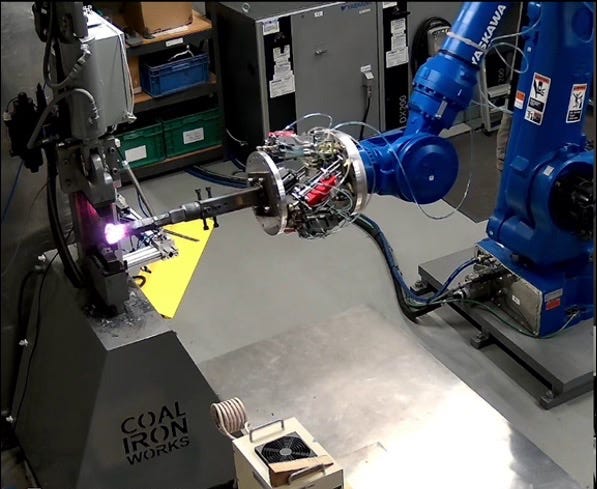
For example, robots in the role of “AI artisans” in manufacturing could speed, simplify and improve upon cases where manufacturing connects to human craft today, as described by Mike Groeber, a faculty director of manufacturing research at The Ohio State University:
In manufacturing, where is autonomy acceptable? The answer partly lies in tasks where humans currently perform unpredictably because they rely on experience, interpretation or judgment. Polishing a part with varying geometry, welding a feature that changes shape from part to part, and adjusting machining strategy based on chip behavior are all situations that have this characteristic of making decisions, sometimes different decisions at different times, based on observation. Teaching machines to handle situations of this type is one of the promising applications of AI.
Groeber illustrated this possibility through work underway at Ohio State’s Artificially Intelligent Manufacturing Systems (AIMS) lab. Researchers there are developing robotic systems that function as what he calls “AI artisans.” The robots are equipped with multiple manufacturing tools in the form of functional end effectors plus a forging press within the robot’s reach, and the system overseeing the robot is trained through simulation to select the sequence of operations needed to produce a part. The system acts within an observe–orient–decide–act (OODA) loop, adapting its actions based on the outcomes it encounters.
These systems operate within defined boundaries, Groeber notes. Because autonomous behavior cannot be predicted, safeguards must be built around it. Monitoring systems can constrain the range of acceptable outcomes, ensuring that AI-driven actions remain within limits established by physics, process knowledge or safety consideration. In other words, autonomy in manufacturing will not bring or entail unlimited freedom for machines, but instead will involve AI operating inside guardrails defined by human engineering understanding.
Within these guardrails, the goal of AI is to extend automation, giving manufacturing systems the ability to respond intelligently to situations too complex or variable to be fully programmed from human knowledge.
That goal has not been reached yet. We don’t need those guardrails yet. But the conversation is important and the need is apt come suddenly because the capability for manufacturing autonomy is not what is missing. Rather, enough data to be sufficient for autonomy is what is missing—and not the mass of data in terms of what is being measured, but simply the amount of data within a proper context for AI to make full use of it.
As my report notes:
Richard Huff, the Director for Industry Consortium and Partnerships with ASTM International, described related work focused on developing high-quality materials data for additive manufacturing. Generating such data is laborious. It requires collecting process parameters, machine data, in-situ monitoring results, heat-treatment information, test coupon data, and materials characterization results. Even within a single organization, assembling these datasets can be expensive and time-consuming. Across companies or machine platforms, the difficulty multiplies. A system for data sharing not only creates a valuable context for datasets, but also reduces the material testing work by providing data access and visibility to potentially reduce redundant testing.
The challenges around data help explain why many AI projects in manufacturing remain in what one speaker described as “pilot purgatory.” Yan Lu of NIST cited research suggesting that only a small fraction of industrial organizations have successfully scaled AI applications in production environments. In many cases, the limiting factor is not the algorithm but the underlying data infrastructure.
Another challenge involves context. Manufacturing data rarely speaks for itself. Without sufficient metadata describing the conditions under which it was generated, even large datasets can be difficult for AI systems to interpret correctly.
Data describing one variety of manufacturing—additive manufacturing—is particularly valuable, because additive is the manufacturing process nearest to needing AI and being able to benefit from it. I have more to say on that point in this article about AM and AI.
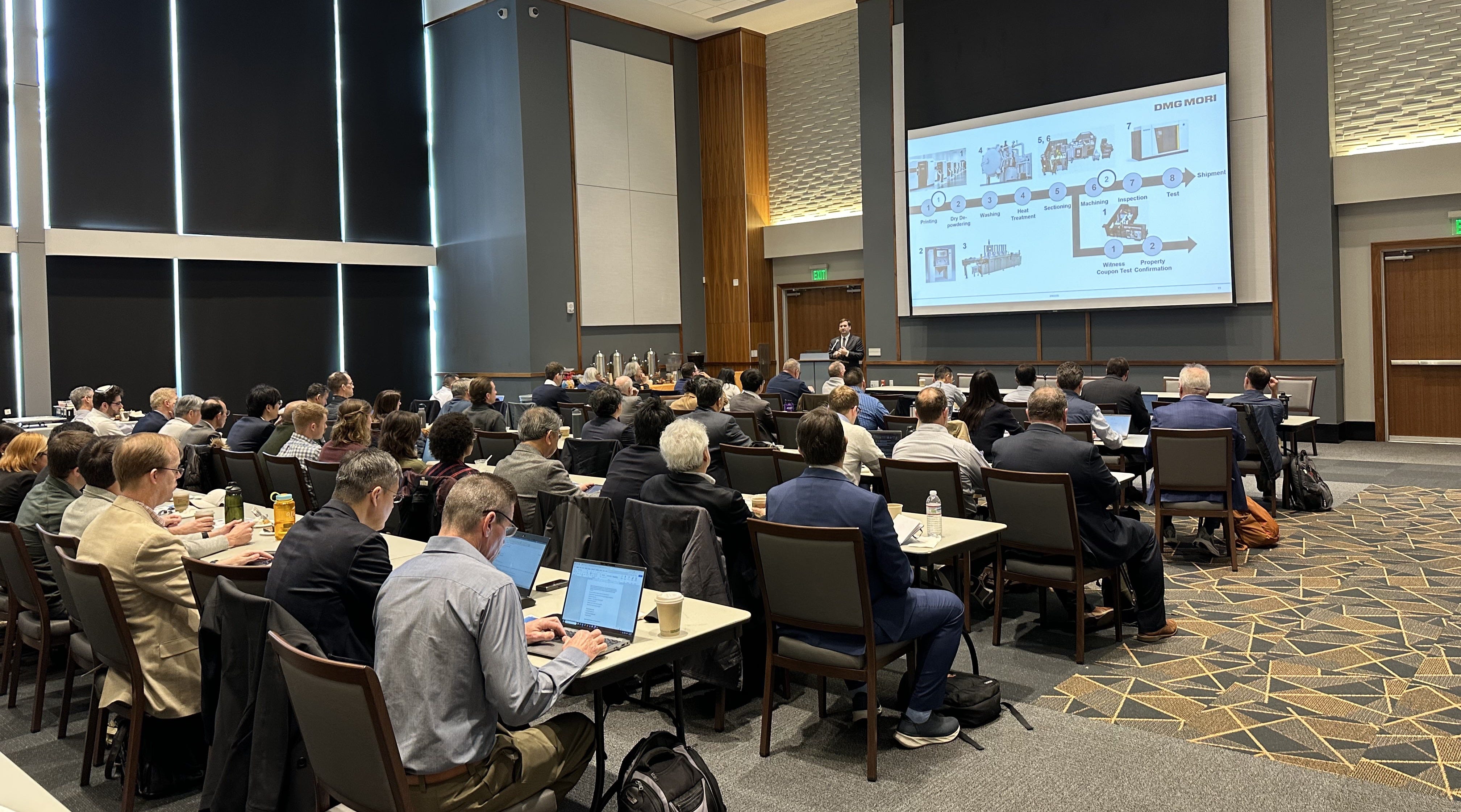
Data gathering and formatting thus comprise the foundational ground game of preparing today for an AI-enabled future of manufacturing. As I say in the report, the “preparation begins with capturing data consistently, preserving the context that gives it meaning, and structuring it so it can be shared across systems.” That these data disciplines generally do not characterize manufacturing today is the chief impediment to AI-enabled and therefore autonomous production. But once there is sufficient quantity and quality of data to train and empower autonomous manufacturing systems, the other components for realizing this promise are liable to be in place or not far off.
My report identifies other gaps or obstacles in the way of realizing AI’s full promise for manufacturing, including one significant misunderstanding. Multiple experts at the workshop referred to this disconnect: C-level executives in manufacturing organizations tend to associate AI and its behavior with large language models (LLMs), notably ChatGPT. That is, generative AI. By contrast, AI in manufacturing will be correlative. I describe why the misunderstanding is sufficiently unhelpful to amount to an impediment:
Manufacturing is not primarily a text environment. Rather, it is an environment of sensor signals, machine parameters, images, material measurements, quality records and process histories. Thus, the form of AI most likely to matter in production is not AI that generates language or content, but AI that can detect patterns, correlate variables, interpret physical conditions and support decisions inside complex process environments. In other words, AI in manufacturing will be less about generation and more about recognition, inference and response.
In short, manufacturing’s variety of AI will not be prone to the “hallucinations” or generative falsehood an LLM might create. Autonomy in manufacturing does mean unpredictability in the sense of processes that test and update their paths or sequence of operation, but not unpredictability at the level of what we sometimes see in our office desktop uses of AI. As AI increasingly takes its place in production, this nuance about the nature of manufacturing AI will become important to see.
Read the complete report here: