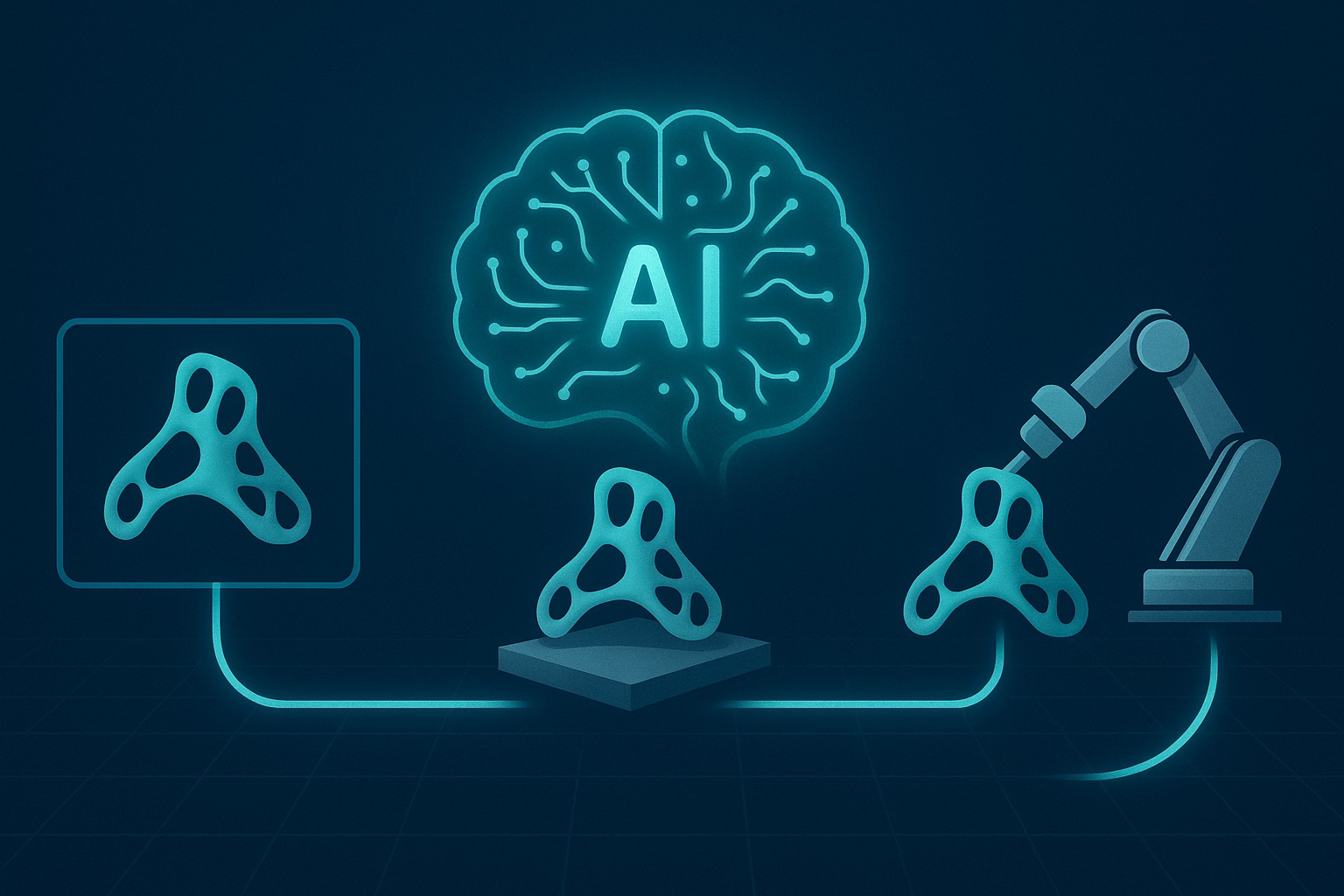
In a report I recently wrote for the ASTM Additive Manufacturing Center of Excellence, I describe the expanding role for AI in fulfilling the promise of additive manufacturing. Here is an excerpt:
That additive manufacturing and artificial intelligence go together is, in an intuitive sense, not hard to see. One is a digital manufacturing technology, while the other is the analysis capability arising from new ways to process lots of data. However, just how they fit together has been less clear. One obvious scenario is this: AI could use the measured outputs of AM to better control the process inputs for precise and nuanced effects related to material properties and thermal management during the build. But as it turns out, that scenario does not sufficiently describe the AI/AM interconnection. Or rather, that scenario does not capture the sole link between AM and AI, or even the primary link as yet.
Download the report here. I detail a variety of different applications in which AI is aiding the advance of AM, all of which connect to projects or technologies presented at the recent International Conference on Advanced Manufacturing, ASTM’s annual manufacturing technology event.
Here is a summary of different areas in which AI is not only helping AM succeed, but also helping it attain to successes only AI and AM could realize:
1. Going from design freedom to many design freedoms
Additive manufacturing allows for geometric complexity. How can that freedom be directed to specific end uses where the information driving the design complexity is itself complex? Two applications I describe are (A) the use of AI to rapidly design military drone airframes for needs identified during a conflict, and (B) tailoring the osseointegration geometry of orthopedic implants to match the bone structure characteristics of an individual patient.
2. Expanding the scope of AM process control
There are more “knobs to turn” in controlling the outcome of an AM process once AI can define them, and in essence chart the wiring for these new knobs. Example: AI is helping researchers understand the effect of dwell time within laser powder bed fusion additive builds, by discovering and mapping the repeatable and controllable effects on part geometry and material properties that dwell time might be used to introduce.
3. Making postprocessing as unattended as the additive build
3D printing can produce a batch of parts with varying geometries all in one unattended build, but this leaves a batch of disparate parts in need of postprocessing operations such as machining. How can this varied work be performed in a way that is also streamlined and largely unattended? As I report, AI-enabled robot cells provide an answer.
4. Normalizing and systemizing AM process development
Given the role of support structures and the interrelationship between part and build design choices and thermal effects, additive manufacturing presents a more complex design challenge than, say, designing for machining or molding. And yet, with AI, “more complex” is a surmountable challenge. New AI-related developments are revealing how the design rules of AM are as defined, predictable and “automatable” as the design rules for other processes.
In the report, I summarize it all this way:
[O]ne of the most significant distinctions separating AM from more conventional processes might be one we are only now coming to see. In design, process control and process optimization, there is not just an AI opportunity, but a role for AI at seemingly every vital stage of the AM value chain.
Since writing the report, I have discovered another interesting shade to this idea. That “obvious” application I mentioned at the beginning—namely: using AI to optimize the process inputs for the desired outputs in AM—might actually prove to be one of the less needed or less meaningful uses of AI for AM. Reason: Using AI to tailor material properties instead might bypass the need for this process optimization.
That will be the subject of my next post.