
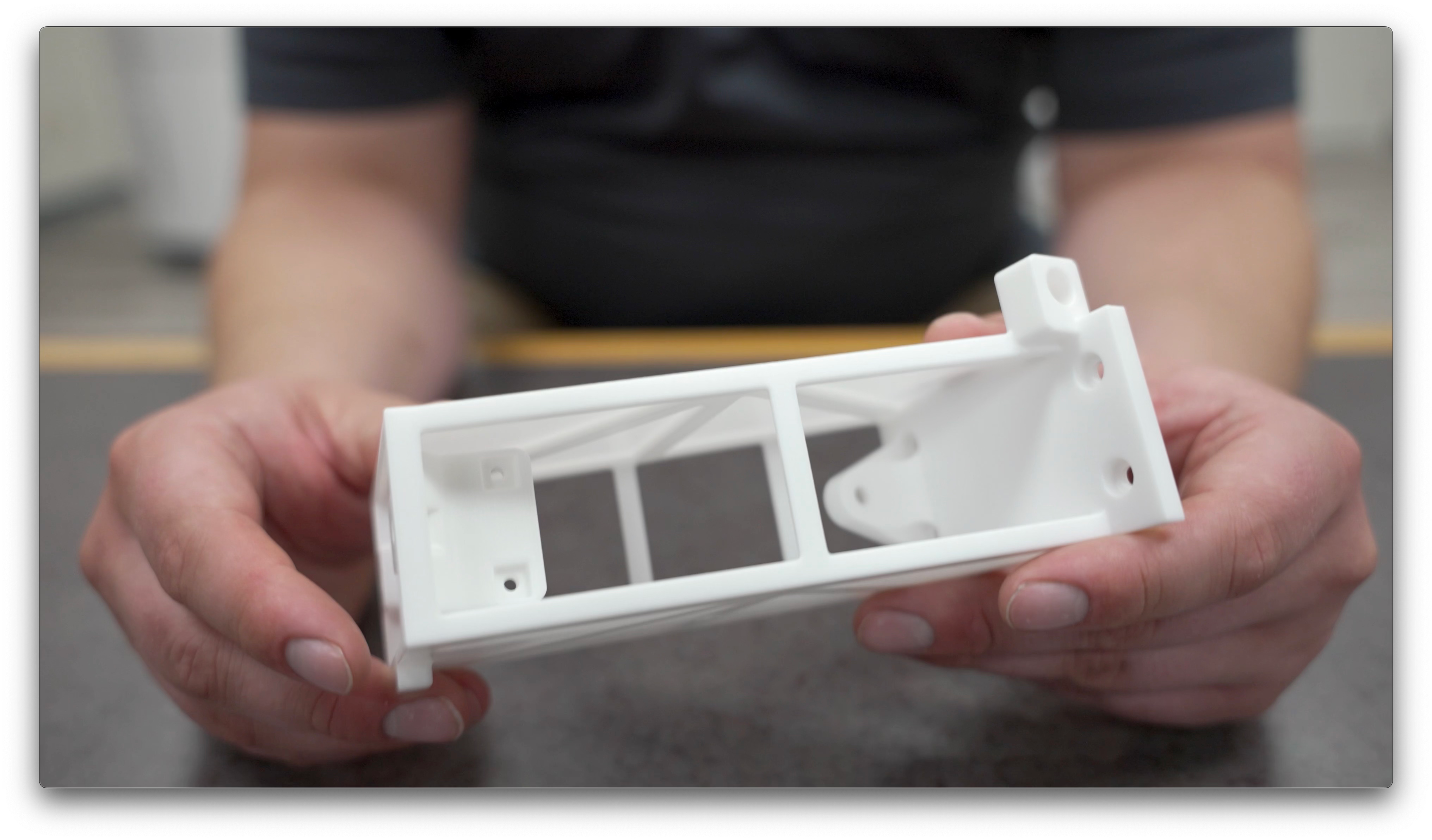
What does “strong” mean in a plastic part? Potentially a lot. In the video below, Nate Stevens of Lifestyle Additive and I unpack that question by looking at several parts made through selective laser sintering (SLS) 3D printing.
“Strong” could refer to:
Rigidity vs. flexibility
Impact vs. fatigue
Strength in a particular location of the part
Strength along a particular direction of loading
In all these cases, part designers tend to think of strength almost exclusively as a material property because they have been trained to do so by injection molding, the usual means of producing plastic components. The part features that are the most effective at making a plastic part strong are generally difficult or impossible to mold. But the same features are straightforward to 3D print, particularly with SLS, which has no support structures to contend with.
The result: With SLS, strength is not just a material property, but increasingly also a design decision.
There is a particularly notable example to be seen in the video, a component that had to combine rigidity and spring-like flexibility within the same solid piece. Watch here: