
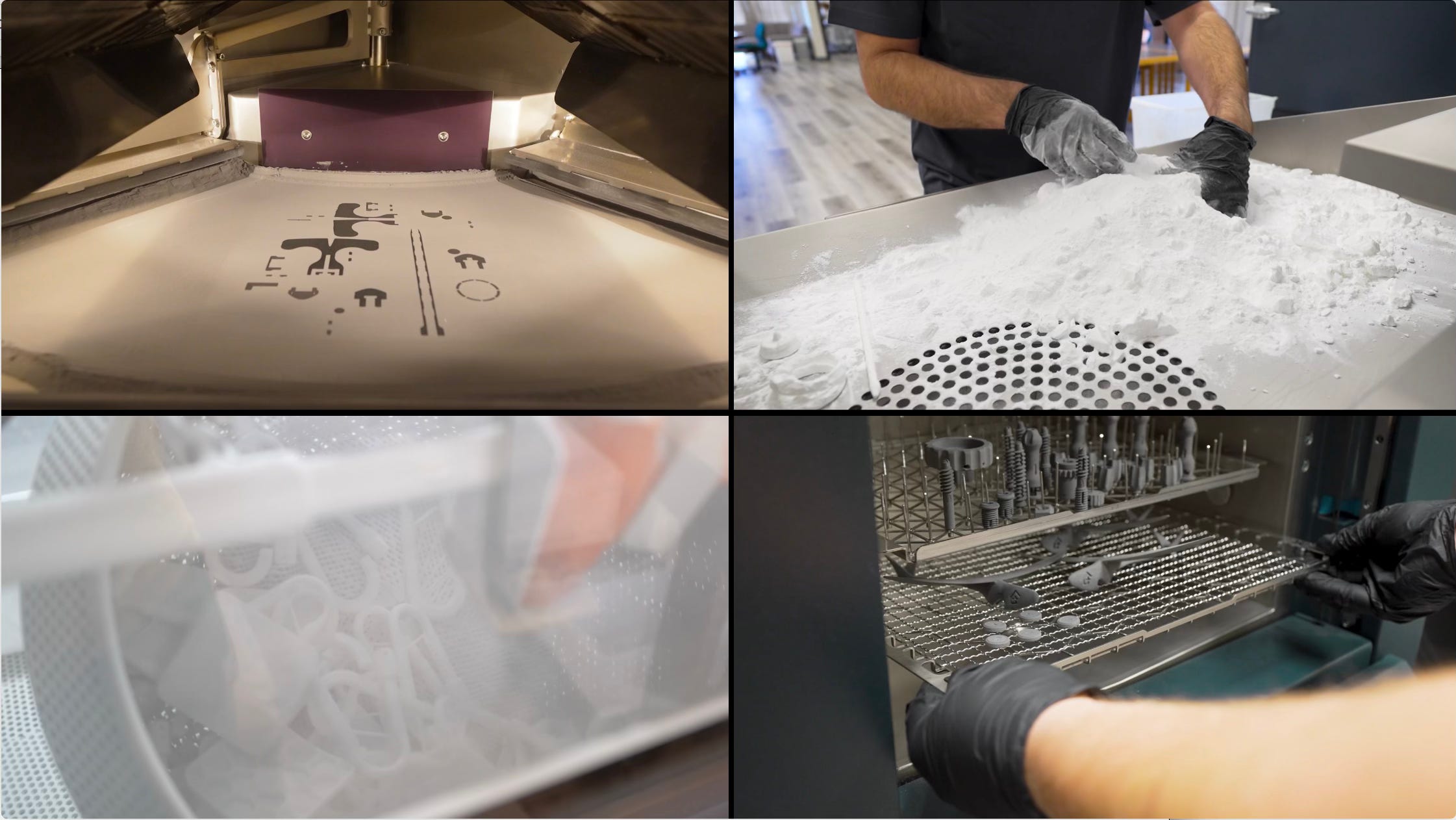
For the final installment in the series of videos I have been filming with Nate Stevens of Lifestyle Additive, we talk about applying selective laser sintering (SLS) additive manufacturing for production. SLS is the AM process that inherently wants to do production, for reasons Nate lays out in the video. They relate to the special characteristics of SLS materials (comparable to polymers already used in established production processes) and the lack of support structures allowing for large quantities per build through 3D nesting.
But the cost is not in the printing. Not all of it, that is, and not even most of it. When it comes to production, the way to understand additive manufacturing is not that it is contained entirely in the 3D printer, but that it consists of all the operations in the sequence following it as well. A streamlined, unattended 3D printing cycle could be followed by a time- and labor-intensive set of steps for powder removal, surface finishing or even inspection. To design a part for production SLS is therefore to design it to speed through the steps that follow SLS, and this video considers what that means.
Example: Adding a hole to the design of one part simply to let it hang from a hook sped the part’s setup time for vapor smoothing. Engineering designers involved in large-quantity production immediately recognize the power and importance of design tweaks such as this. SLS is the AM process capable of such large quantities that the “seconds matter” mindset of production enters into succeeding with this process as well.
Watch the video: